The symbols on food in the United States are shown below. These different stickers placed on packages DO NOT MEAN the same thing. Please do not buy the “verified” products. We won’t either. Marketing geniuses think you will memorize the non gmo symbol and automatically/unconsciously think it is a good product and safe/organic in some way…it is not! Know the facts. Eat healthy. Be well:


Biofortified food is a crop or food product that has been nutritionally enhanced through breeding, genetic modification, or agronomic practices to increase its content of essential vitamins, minerals, or other nutrients. Sounds honorable and all doesn’t it….it’s not. These products/seeds are sterile and modified to attract the consumer and enhance shelf life…not nutrition. They think we are stupid. 
Comments
Breeding and agronomic processes have been practiced by humans since farming began. Where do you think heirloom varieties come from?
Response from Taverna Manos
Tommy B. Yes and no. The quickest answer to your response is: Heirloom tomatoes likely originated in Central and South America, where tomatoes were first domesticated by indigenous peoples around 7000 BCE. The term “heirloom” refers to open-pollinated varieties passed down through generations, often predating modern hybrid cultivars developed in the 20th century. Specific heirloom varieties, like those we know today (e.g., Brandywine or Cherokee Purple), began to be documented and preserved in Europe and North America in the 19th century by farmers and gardeners who valued their unique flavors and traits. The exact “start” of heirloom tomatoes as a concept ties to these traditional practices of seed-saving, with no single point of origin but rather a cultural evolution across regions. (Generations prior did not modify the plants’ cell structures and simultaneously inhibit their reproductive ability via seed sterilization – like they do today) For the record I was a grower and had a small rural farm with greenhouses for almost 20 years my Greek lineage/family members are seed savers for generations – no gmo products eaten there – just natural evolution of seeds for centuries.
Taverna Manos post/comments July 17:
A little additional background Tommy B, et al … Back in 2008 one of my companies had the distinct pleasure of working on the transcripts with a local Citrus County indie film\movie producer Phil Courter, who made and produced a documentary about an exceptionally brilliant man, Normal E. Borloug. Borloug worked on genetically modifying many crops over his lifetime, especially noted for improving rice to stave off starvation and nutrient deficiency in Asia. He received the Nobel Prize for his work. Read about Norman Borloug in the linked profiles. He was a fascinating man! So when I post things about poisons and problems in our food chain, I’m not just spouting someone else’s thoughts or rants…it’s because I was a grower for years, my family in Greece are all seed savers for hundreds of generations, I worked with university research, medicine and science, with a sound basic understanding of the protocols and ethics involved and now I serve food to people – people I like a lot… my neighbors and friends. It’s also because I remember a time when “science and Ag” meant ethics and scruples. just sayin…
Norman Borlaug – Biographical – NobelPrize.org

WHY (and with what) ARE THEY MISTING OUR VEGGIES AND FRUIT?
The Truth About Grocery Store Misting…That’s Not Water Being Sprayed On Vegetables & Fruit. At one time or another, we’ve all been “misted” at the grocery store….But that’s not WATER!! It’s called Produce Maxx, A Chemstar Product, Contains Sodium Hypochlorite, Commonly Known As Liquid Bleach. The tiny misters in your grocery store produce section contain antimicrobial sprays that are leaving your fresh fruit & vegetables covered in chemicals — even if they’re organic.
Chemstar’s “Sterilox Produce Maxx” product is an antimicrobial fruit & vegetable wash used by more than 50 retail brands across more than 10,000 stores throughout North America. FDA & EPA approval for all produce including certified organic. Produce Maxx, is just one type of antimicrobial spray used on produce, and it contains Sodium Hypochlorite, a form of free chlorine, at a high concentration of 6,000 parts per million (ppm). For comparison, the Centers for Disease Control and Prevention (CDC) recommends free chlorine concentrations of no more than 4 ppm for maintaining safe drinking water.
Similarly, in swimming pools & spas, free chlorine levels are typically maintained within the range of 1 to 3 ppm to ensure effective disinfection without causing irritation to swimmers. Chlorate, one of the byproducts of Sodium Hypochlorite degradation, poses health risks. Human exposure to chlorate can cause gastritis, toxic nephritis, hemolysis, methemoglobinemia, hemoglobinuria & acute renal failure.
👇Produce Maxx Package Insert👇
https://www3.epa.gov/pesticides/chem_search/ppls/046597-00004-20210624.pdf
👇Chemstar Corporation Produce Maxx👇
https://chemstarcorp.com/producemaxx/
👇The Harms Of Ingested Sodium Hypochlorite👇
https://mountsinai.org/health-library/poison/sodium-hypochlorite-poisoning
Please watch your young children/grandchildren who are standing nearby/under these misters! Chemstar Says Avoid Inhaling Vapors & They Have Legal Immunity If You’re Harmed. Produce Maxx isn’t just confined to the misting sprays at select grocery stores; it’s even used in pre-cut vegetables & fruit! It serves various purposes, including misting, crisping treatment & washing. Chemstar advises customers to avoid inhaling vapors, sprays & mists…& the fine print absolves them of liability for any problems arising from the product.
Produce Maxx:
✅ Requires a minimum soak time of 90 seconds to be effective
✅ Controls spoilage-causing bacteria to extend shelf life
✅ Approved for use on whole & cut fruits & vegetables
✅ No water rinse required after application
Produce Maxx Used In The Following Ways:
This chlorine-based solution isn’t just being used in washing—it’s also being misted directly onto produce that sits on store shelves.
Common Produce Maxx applications include:
➖Crisping – Keeping leafy greens & vegetables looking fresh
➖Washing – Used during pre-packaging or store handling
➖Cut Fruit Preparation – Treating ready-to-eat produce
➖Misting – The mist you see in grocery stores is not water
Some of the major grocery chains using Produce Maxx:
🔺 Albertsons
🔺 Vons
🔺 Sprouts
🔺 Amazon Fresh
🔺 Ralph’s
🔺 Safeway
🔺 Whole Foods
🔺 Smart & Final
🔺 H-E-B
🔺 Cub
🔺 Stater Bros
🔺 Raley’s
🔺 Save Market
FUNGICIDES AND RESIN ON OUR CITRUS?!
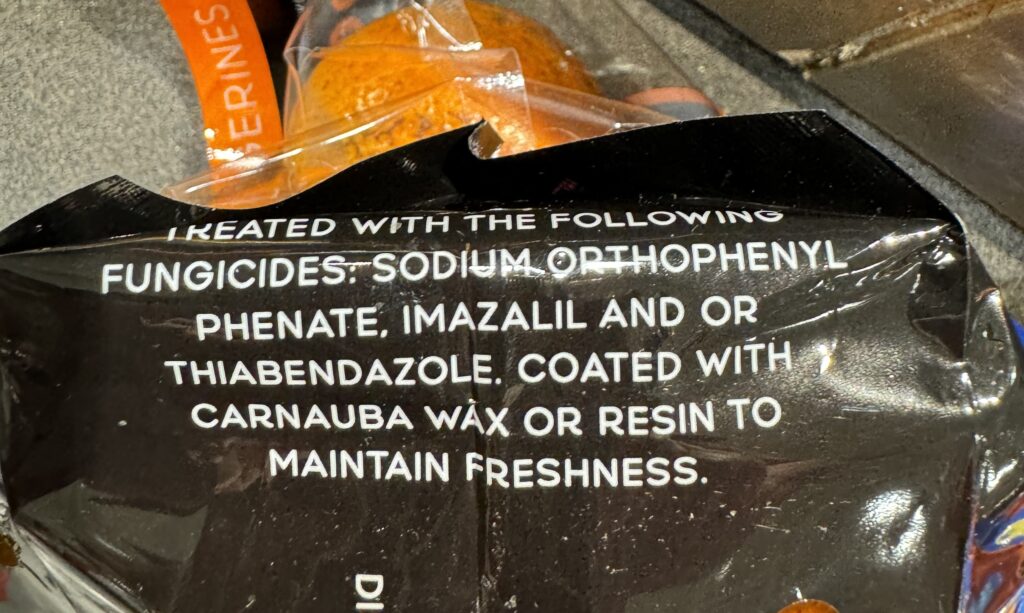
“To Maintain Freshness” omg…seriously!??? This is the warning label on your citrus products. I just happened to be at at our local upscale grocery store, when I took this picture – but it’s everywhere on all citrus bags. They are spraying three different fungicides on your citrus! Washing does not stop the fungicide from seeping through the rind and entering the fruit. Fungicides on oranges can pose health risks, particularly for children. Conventional citrus fruits, including oranges, may contain harmful levels of certain pesticides, which can be concerning for consumers. While organic oranges typically do not have detectable levels of fungicides, it’s important to be aware of the potential risks associated with conventionally grown citrus.
Carnauba wax or resin? Carnauba wax is used for car finishes to protect the paint job from the blazing sun….Uh…no thanks! Imazalil is not only a hormone disrupter; the EPA classified it as “likely carcinogenic to humans” in 1999. And according to the EWG, “The average concentration of imazalil detected in all fruits tested was about 20 times the amount that EWG scientists recommend as a limit to protect children against increased risk of cancer…” Similarly, in an assessment of thiabendazole, the EPA has stated that it is known to cause “harm to the immune and nervous systems and thyroid in adult animals.”
Along with the whole fruit, commercially produced juices—particularly orange—are also problematic. USDA testing of 176 non-organic orange juice samples found that 21% had detectable levels of imazalil and 35% had thiabendazole. The one bright spot here is that juices usually contain less of these fungicides than whole fruits. Fruits harvested for juicing are typically processed right after they’re picked, which reduces the need for post-harvest fungicides. I hate posting this type of thing, but you gotta know  – Despina
It’s summer in Florida – let’s get grilling! But always know the correct temp of the food to keep the family safe:


Refrigerated Food and Power Outages: When to Save It and when to throw it out!
| Type of Food | Exposed to temperatures of 40°F (4°C) or above for more than 2 hours |
| Meat, poultry, seafood | |
| Raw or leftover cooked meat, poultry, fish, or seafood; soy meat substitutes | Discard |
| Thawing meat or poultry | Discard |
| Salads: Meat, tuna, shrimp, chicken, or egg salad | Discard |
| Gravy, stuffing, broth | Discard |
| Lunchmeats, hot dogs, bacon, sausage, dried beef | Discard |
| Pizza with any topping | Discard |
| Canned hams labeled “Keep Refrigerated” | Discard |
| Canned meats and fish, opened | Discard |
| Casseroles, soups, stews | Discard |
| Cheese | |
| Soft cheeses: blue/bleu, Roquefort, Brie, Camembert, cottage, cream, Edam, Monterey Jack, ricotta, mozzarella, Muenster, Neufchatel, queso blanco, queso fresco | Discard |
| Hard cheeses: Cheddar, Colby, Swiss, Parmesan, provolone, Romano | Keep |
| Processed cheeses | Keep |
| Shredded cheeses | Discard |
| Low-fat cheeses | Discard |
| Grated Parmesan, Romano, or combination (in can or jar) | Keep |
| Dairy | |
| Milk, cream, sour cream, buttermilk, evaporated | Discard |
| Type of Food | Exposed to temperatures of 40°F (4°C) or above for more than 2 hours |
| milk, yogurt, eggnog, soy milk | |
| Butter, margarine | Keep |
| Baby formula, opened | Discard |
| Eggs | |
| Fresh shell eggs, eggs hard-cooked in shell, egg dishes, egg products | Discard |
| Custards and puddings, quiche | Discard |
| Fruits | |
| Fresh fruits, cut | Discard |
| Fresh fruits, uncut | Keep |
| Fruit juices, opened | Keep |
| Canned fruits, opened | Keep |
| Dried fruits, raisins, candied fruits, dates | Keep |
| Sliced or shredded coconut | Discard |
| Sauces, Spreads, Jams | |
| Opened mayonnaise, tartar sauce, horseradish | Discard (if above 50°F (10°C) for more than 8 hrs) |
| Peanut butter | Keep |
| Jelly, relish, taco sauce, mustard, catsup, olives, pickles | Keep |
| Worcestershire, soy, barbecue, hoisin sauces | Keep |
| Fish sauces, oyster sauce | Discard |
| Opened vinegar-based dressings | Keep |
| Opened creamy-based dressings | Discard |
| Spaghetti sauce, opened | Discard |
| Bread, cakes, cookies, pasta, grains | |
| Bread, rolls, cakes, muffins, quick breads, tortillas | Keep |
| Refrigerator biscuits, rolls, cookie dough | Discard |
| Cooked pasta, rice, potatoes | Discard |
| Type of Food | Exposed to temperatures of 40°F (4°C) or above for more than 2 hours |
| Pasta salads with mayonnaise or vinaigrette | Discard |
| Fresh pasta | Discard |
| Cheesecake | Discard |
| Breakfast foods: waffles, pancakes, bagels | Keep |
| Pies and pastry | |
| Cream filled pastries | Discard |
| Pies: Any with filling containing eggs or milk, e.g., custard, cheese-filled, or chiffon; quiche. | Discard |
| Fruit pies | Keep |
| Vegetables | |
| Fresh vegetables, cut | Discard |
| Fresh vegetables, uncut | Keep |
| Fresh mushrooms, herbs, spices | Keep |
| Greens, pre-cut, pre-washed, packaged | Discard |
| Vegetables, cooked | Discard |
| Tofu, cooked | Discard |
| Vegetable juice, opened | Discard |
| Baked potatoes | Discard |
| Commercial garlic in oil | Discard |
| Potato salad | Discard |
| Casseroles, soups, stews | Discard |
